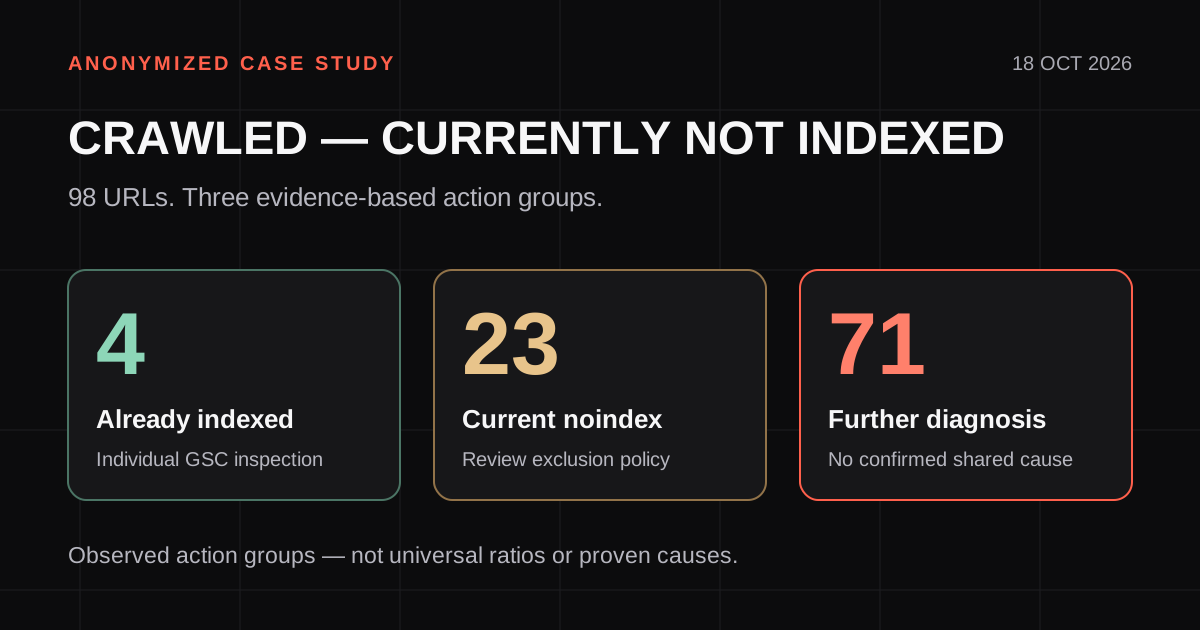
Of 98 URLs listed under Crawled — currently not indexed, 71 remained candidates for further investigation after reconciling the evidence. Individual Google inspections already reported four as indexed, while the current final pages for 23 original addresses contained noindex. These are findings from our audit, not a universal ratio or a success story about getting 98 pages back into search.
This anonymized case concerns a multilingual educational website examined on October 18, 2026. The domain and original addresses are withheld; examples retain stable identifiers U001–U098. We did not edit pages, request indexing or submit a validation request. Our contribution is the address-by-address comparison between the aggregate report, URL Inspection and the current public HTTP response.
What exactly did we investigate?
The exclusion group displayed 98 URLs, with the examples table showing rows 1–98 of 98. We recorded that entire available list and opened the individual inspection for every address, expanding its indexing section. Membership in the original group remained fixed throughout the analysis. An address was not removed from the denominator when its individual status changed: doing so would hide precisely the discrepancies we were trying to measure.
The report header carried an October 12 update label, although some example rows already showed later crawl dates. We retained both observations instead of assigning one freshness date to every field. Five individual inspections showed a different last-crawl date from the examples table. This is a reason to preserve field-level dates alongside the collection date, not to assume every report was captured at the same moment.
Google describes the status as a fetched page that has not been indexed; it does not specify an individual cause. Google recommends URL Inspection for a particular address, and the examples list may be incomplete. Our conclusions therefore concern these 98 observed rows, not every URL on the website. Google's report and status documentation.
How did we keep the three evidence layers separate?
| Source | What we recorded | What it does not establish |
|---|---|---|
| Aggregate indexing report | Original group, address and row-level crawl date | That the old label describes the URL right now |
| URL Inspection: indexed data | Status, crawl, access, directives and canonical fields where available | That Google's stored version matches today's website |
| Public HTTP GET | First response, redirect chain, final HTML, robots and canonical | That Googlebot received the same response or indexed that version |
We fetched pages without authentication and without impersonating Googlebot. We also downloaded the current sitemap and checked exact membership for each original address. Links were extracted from HTML within the investigated cohort; we did not crawl the entire website. This scope can establish that a discovered link exists. It cannot establish that a page is an orphan merely because no incoming link appeared in the limited sample.
We did not run GSC's live-page test. Even that test answers a different question from the indexed-data view and does not confirm actual index inclusion. Our ordinary HTTP check is narrower still. Keeping those boundaries explicit prevents a successful fetch from being presented as a successful indexing outcome. URL Inspection capabilities and limitations.
What did all 98 inspections actually confirm?
Every count in the following tables is our own observation from October 18, 2026. The first table contains only individual GSC statuses. It does not silently replace them with directives found on the current website.
| URL Inspection status | URLs | Interpretation |
|---|---|---|
| Indexed | 4 | The exclusion list no longer matches the individual result |
| Crawled — currently not indexed | 93 | The status persists; a specific cause remains unproven |
| Excluded by noindex | 1 | Google explicitly reports a detected directive |
| Total | 98 | Each original address is counted once |
All inspection records reported that crawling was allowed and the page fetch succeeded. However, the indexing-allowed field was unavailable in 27 records. We did not convert an unavailable value into a positive result. Missing evidence is not evidence that a requirement has been satisfied.
The current HTTP check produced a different breakdown: 97 original addresses returned a direct 200 response, while one followed 301 → 301 → 200. The final pages reached from 23 addresses contained noindex. The other 75 declared index, follow, had self-referencing canonicals and appeared in the current sitemap. Sitemap membership records an owner's submission choice; it is not confirmation of indexing. What a sitemap can and cannot do.
Why did the investigation queue shrink to 71 URLs?
For action planning, we combined the evidence without relabelling Google's results. The resulting groups do not overlap in this cohort: four addresses were already indexed, 23 had a current restriction on the final page, and 71 lacked confirmed indexing without a detected current restriction. The calculation is 98 − 4 − 23 = 71. This is an investigation queue, not a count of proven technical faults.
| Action group | Count | Next step |
|---|---|---|
| Already indexed | 4 | Evaluate performance and usefulness, not an obsolete exclusion label |
| Current noindex | 23 | Confirm the intended editorial exclusion policy |
| Needs further diagnosis | 71 | Investigate content, links, duplication and rendering |
Of the 23 currently restricted final pages, 21 were lesson exercises. Their HTML pointed the canonical to the corresponding main lesson, and the available exercise template explicitly set noindex. The remaining cases were a glossary entry and a category reached through redirects. These addresses were absent from the current sitemap. There is no basis for removing the directive from this entire group merely to reduce the report's exclusion count. Search eligibility should follow an explicit editorial decision about each page's purpose.
A noindex directive is an indexing restriction, not a content-quality repair. Google needs access to the page to read it. That distinction is important when reviewing an intentionally excluded utility page. Google's noindex guidance.
Which examples separate observations from explanations?
| Example | Confirmed observation | Not established |
|---|---|---|
| U009: tool page | The table showed a September 27 crawl; individual inspection showed October 16 and indexed status | That our investigation or any particular edit caused indexing |
| U011: exercise | Inspection reported noindex; current HTML confirmed it and a canonical pointing to the lesson | That the exercise's absence from search is a malfunction |
| U012: another exercise | Stored September 9 data allowed indexing; current HTML contained noindex | When the directive changed or why the earlier Crawled status occurred |
| U079: lesson | Stored May 29 data showed no declared canonical; current HTML contained one | That the earlier missing declaration caused exclusion |
| U080: parameter URL | The current path contained two successive 301 responses, ending on a noindex category | That shortening the chain would get the original URL indexed |
For U080, replacing the intermediate hop with a direct redirect is a concrete option worth reviewing. It addresses an observed chain, but should not be sold as a cure for a historical indexing status. For U079, there is no reason to add a canonical that already exists in the current response. First reconcile the dates. Nor does a canonical declaration command Google to select that exact address. Canonicalization guidance.
Which alarming fields did not prove a fault?
The sitemap field displayed a temporary processing error in 50 inspections. That set included three of the four indexed pages. In this dataset, therefore, the message alone is not a sufficient explanation for exclusion. We confirmed its presence, but not its cause, duration or effect. The current sitemap returned 200 and parsed as XML during our request. That observation does not establish what Google received at every earlier attempt.
GSC displayed no referring page for 16 addresses. Nine of those addresses nevertheless had incoming links from other pages inside our examined cohort. These are observations from different evidence layers and dates, not proof of a Google reporting defect. The useful conclusion is narrower: an empty referring-page field is not a reliable orphan-page diagnosis. The remaining addresses require a full site crawl; an incomplete link check cannot settle the question.
This changes the work order. Instead of instructing someone to “repair every sitemap error and link every orphan,” ask them to verify actual file availability and build the current internal-link graph. A reproducible question produces better evidence than a diagnosis copied from a field label. It also makes the eventual intervention easier to assess.
Which possible causes are still hypotheses?
| Hypothesis | Missing evidence | Useful test |
|---|---|---|
| The page duplicates nearby content | A substantive comparison of content and reader tasks | Compare main content, intent and independent usefulness |
| Internal linking is insufficient | A full link graph and review of important sections | Crawl the website and inspect navigation and contextual links |
| Important content fails to render | Rendered-page and resource evidence | Inspect the published page and the version available to Google |
| A recent revision has not been recrawled | Release history aligned with Google's crawl dates | Record the change date and observe the next recorded crawl |
We did not establish a common exclusion cause for the 71 remaining candidates. Labels such as “thin content,” “penalty,” “crawl-budget shortage” or “Google dislikes translations” are not supported by this evidence. They do not belong in the confirmed-problems column. A better next step is to choose a small group of pages with a clear reader purpose, define a test for each and preserve the baseline before editing.
What can this method and the tool not do?
The GSC URL Auditor for checking an export can support the next technical review. This case's figures came from the separate checks described above; they are not presented as a tool-generated result. Neither an HTML fetch nor an audit table reveals Google's internal decision, automatically measures usefulness or supplies a complete link graph without the relevant crawl.
This was a single-site investigation, not a controlled experiment. It contains no before-and-after intervention results, measured click uplift or causal proof. A recrawl request would not establish those outcomes either, and does not promise inclusion in results. Limitations of requesting a recrawl.
What should you do with your own export next?
Keep the original cohort, assign stable identifiers and separate the report, individual inspection and current website evidence. Do not change the denominator when an indexed address appears. For each proposed intervention, record the observation, hypothesis, expected verifiable outcome and date. That creates a basis for distinguishing a real page change from an update to the reporting layer.
Begin the technical comparison in the URL auditor. Use the Crawled — currently not indexed definition for terminology and the indexing diagnosis playbook for the workflow. The useful output is a justified action queue, not a promise to eliminate every exclusion.