Data analyst portfolio
Alexander Yarovenko
Data analyst · SEOKit founder
From conflicting metrics to a decision you can explain.
I build SEOKit and work with Google Search Console and GA4 data. My focus is repeatable analysis: reconcile the sources, check the evidence and show what to investigate next.

Selected work / SEOKit
GSC + GA4: investigating a change in organic traffic
A data analyst portfolio project built into a working product. One investigation connects search visibility, landing-page sessions and the limits of what the data can establish.
The business question
Which pages gained or lost traffic, and is there enough data to recommend changes to the site?
Align the comparison
Use the same comparison periods and record source time zones, filters and extraction coverage.
Reconcile landing pages
Match hostname and path, expose unmatched URLs and identify missing data separately from recorded zero values.
Separate facts from hypotheses
Show the observed change, evidence, limitations and next check. An impression decline alone does not prove a demand decline.
A useful outcome can be “not enough evidence”
The saved real run exposed low traffic volume, incomplete coverage, unmatched GA4 pages and different source time zones. The report keeps the measured totals but withholds a confident causal explanation.
Next: check which landing pages could not be matched, confirm which GA4 event represents the business goal, and collect more comparable data before recommending changes.
What makes the conclusion reviewable?
- Source traceability
- The report refers to a saved run and its comparison periods. Rerunning a calculation does not silently rewrite the original source snapshots.
- Data quality checks
- Matching coverage, absent rows and incompatible source settings remain visible. Missing values are reported separately so they do not distort the calculations.
- Explainable rules
- “Explanation of changes” uses evidence-based rules. Each explanation can be checked against the source metrics and calculation rules.
What this case does not measure
There are no verified ad-cost, payment or subscription datasets in this case. It does not establish CAC, ROAS, LTV or revenue uplift. Public material shows the method and interface; original account-level reports remain private.
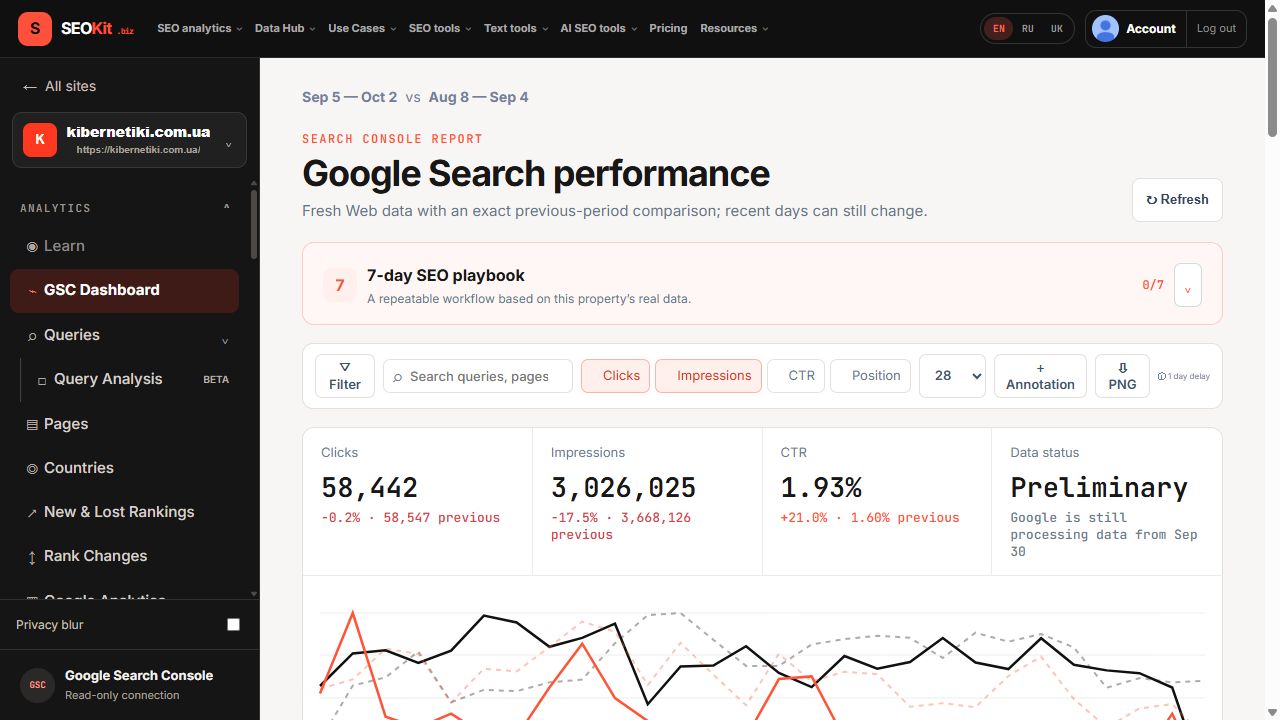
Product overview. Connecting your own Google data requires sign-in.
02 / Methods
Data analysis skills, with a place to apply them
The project connects engineering habits with analytical reasoning. Each method has a concrete purpose.
Python data analysis
Automate API data handling, normalize page identifiers and make report calculations repeatable.
Data quality and validation
Use QA experience to test boundaries, incomplete extracts, saved results and discrepancies between sources.
Data visualization
Make period comparisons, page-level changes and uncertainty readable in the product’s reports.
03 / Learning
SQL, Power BI and statistics: current training
I am developing my SQL, BI and statistics skills at DAN.IT and Hillel. The current focus is querying data, building reports and testing hypotheses.
Business Intelligence
SQL, Python and Power BI: working from a business question to data preparation and reporting.
View programmeData Analytics Pro
Python, pandas, SQL, statistics, A/B testing and BI. Building a stronger foundation for analytical decisions.
View programmeCompleted training and credentials
Documents for completed training. Programmes in progress are listed separately above.
- Python Developer · ITVDN ↗September 2026 · TP78393910D
- SEO Specialization · UC Davis / Coursera ↗May 2026
- SEO Pro · WebPromoExperts ↗June 2025
- Google Ads Measurement · credential record ↗
- SEO School — Artem Pylypets · August–December 2024
A path through QA, SEO and analytics
- 2026 — present
Data analysis in SEOKit
GSC/GA4 reconciliation, Python automation and evidence-based reports in my own product.
- 2024 — present
SEOKit founder
Developing a product for search analysis, technical checks and content workflows.
- 2021 — 2024
QA Engineer
Web and mobile testing, API testing with Postman, Python automation and work in Scrum teams.
- Earlier
SEO copywriting
Keyword research and content work: the context behind search intent and page performance.
04 / Contact
Let’s discuss an analytical problem
For a role, an interview or a discussion of the SEOKit case, send me the context and the question you want to answer.